Staff Augmentation vs. Managed Services vs. Dedicated Teams: Which Is Right for Your Business?
By GreyloopsUpdated 17 min read
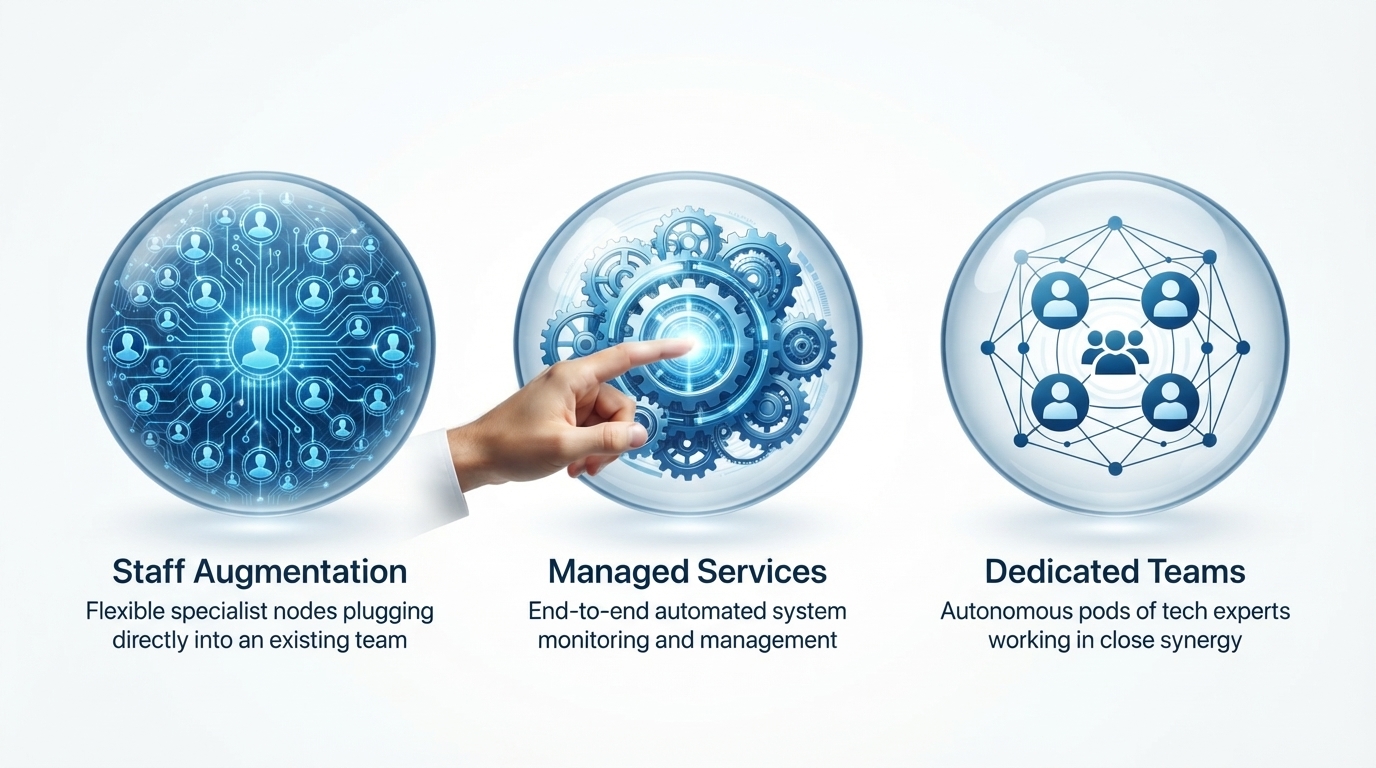
Staff augmentation, managed services and dedicated development teams are the three most common ways to work with a software development partner, and choosing the wrong one costs time, money and momentum. This guide explains how each IT engagement model works, compares them side by side on control, cost and responsibility, and helps you decide which is right for your business.
What is the difference between staff augmentation, managed services and a dedicated team?
IT staff augmentation adds individual external specialists to your existing team. You manage them day to day. Best for filling skill gaps or adding short-term capacity.
Managed IT services hand responsibility for an IT function, such as cloud, security or application support, to a provider under an agreed service level. Best for ongoing operations.
A dedicated development team is a complete, long-term team that works only on your product. Best for building and continuously improving software without hiring a full in-house team.
What Is an IT Engagement Model?
An IT engagement model defines how a business works with an external technology partner: who provides the people, who manages the day-to-day work, who is accountable for results, and how the work is priced. The three most common models are IT staff augmentation, managed IT services and dedicated development teams.
Every business has different technology requirements, budgets, timelines and internal resources. Some organizations need extra developers to support an existing team, some need a complete team to build a digital product, and others want an external partner to take over ongoing IT operations. Each of these needs maps to a different engagement model.
Understanding these differences helps businesses select an engagement model that aligns with their goals, provides access to the right expertise, and supports long-term growth. In this guide, we will compare these three models, explore their benefits and limitations, and explain how to choose the right approach for your business.
What Is IT Staff Augmentation?
IT staff augmentation is a hiring model in which businesses bring in external IT professionals to support their existing teams. Instead of hiring full-time employees, companies can work with skilled developers, software engineers, QA testers, UI/UX designers, and other technology specialists for a specific period or project.
This model allows businesses to fill skill gaps, manage increased workloads, and accelerate development without going through a lengthy recruitment process. The external professionals work alongside the company's in-house team and follow its workflows, tools, and project requirements.
For example, if a company is developing a mobile application but lacks experienced mobile developers, it can use IT staff augmentation to bring in additional specialists. The company's internal team continues to manage the project, while the augmented professionals contribute their technical expertise to meet development goals.
Key Benefits of IT Staff Augmentation
When Should You Choose IT Staff Augmentation?
IT staff augmentation is a suitable option when your business already has an internal team but needs additional expertise or capacity. It works particularly well when you need to meet tight deadlines, develop new features, support a temporary workload increase, or access specialized technical skills without expanding your permanent workforce.
However, your internal team generally remains responsible for managing the augmented professionals and overseeing project delivery. If you need an external provider to take responsibility for an entire service or deliver a complete development team, another engagement model may be more appropriate.
What Are Managed IT Services?
Managed IT services are an engagement model in which a business partners with an external IT service provider to manage, maintain, and support specific technology systems or ongoing IT operations. Instead of handling every technical responsibility internally, organizations can rely on a service provider like Greyloops to manage agreed IT functions and ensure their technology continues to operate efficiently.
Depending on business requirements, managed IT services can include cloud infrastructure management, cybersecurity, application maintenance, system monitoring, DevOps, software updates, technical support, and IT infrastructure management. The service provider takes responsibility for the agreed services, monitors performance, addresses technical issues, and helps maintain system reliability according to defined service expectations.
For example, an organization may have an existing mobile application but lack the internal resources to maintain its backend, monitor its cloud infrastructure, resolve technical issues, and release regular updates. Through managed IT services, the organization can partner with Greyloops to handle these ongoing responsibilities while its internal team focuses on core business operations and new opportunities.
Key Benefits of Managed IT Services
When Should You Choose Managed IT Services?
Managed IT services are suitable for organizations that need ongoing technical support, maintenance, monitoring, or management of their technology systems. This model is particularly useful when a business wants to maintain existing software, improve infrastructure reliability, strengthen cybersecurity, or reduce the operational workload on its internal IT team.
With Greyloops, businesses can work with a technology partner to manage agreed IT services, maintain application performance, and support evolving technology requirements. The scope of responsibility, service levels, response times, and reporting arrangements can be defined according to each organization's needs.
What Is a Dedicated Development Team?
A dedicated development team is an engagement model in which a software development company provides a complete, long-term team that works exclusively on your product. The team can include developers, UI/UX designers, QA engineers, DevOps specialists, business analysts and a project manager, and it operates as an extension of your business without you having to recruit each role yourself.
Unlike staff augmentation, which adds individual specialists to a team you already manage, a dedicated team is a self-organizing unit with the full mix of skills needed to design, build, test and release software. Unlike managed services, which focus on running and maintaining agreed IT functions, a dedicated team is focused on building and evolving a product over time.
For example, a company planning a new SaaS platform may not have an in-house engineering department. Instead of hiring a full team from scratch, it can partner with Greyloops for a dedicated team of mobile and backend developers, a designer and QA engineers who work only on that product, while the company sets priorities and owns the roadmap.
Key Benefits of a Dedicated Development Team
When Should You Choose a Dedicated Development Team?
A dedicated team is a strong fit when you are building a new product or platform, need continuous development over months or years, and do not have (or do not want to build) a complete in-house engineering team. It suits startups launching a product, companies expanding into new digital services, and enterprises that need extra product capacity alongside their own teams.
It is less suitable for short, tightly defined tasks, where staff augmentation is usually simpler, or for keeping existing systems running, where managed services provide clearer service levels.
Staff Augmentation vs. Managed Services vs. Dedicated Teams: Key Differences
Staff augmentation, managed services, and dedicated development teams offer different ways for businesses to work with an external software development company. Although all three models provide access to technical expertise, they differ in how professionals are assigned, who manages the work, and who is responsible for delivering the expected outcomes.
Understanding these differences helps organizations choose an engagement model that matches their project requirements, internal capabilities, budget, and long-term technology goals.
1. IT Staff Augmentation
With IT staff augmentation, a business hires developers and other technical specialists from a software house to extend its existing team. The external professionals work under the client's day-to-day direction and follow its development processes.
Best suited for: Businesses that already have a development team but need additional developers, specialized skills, or extra capacity to meet project deadlines.
Example: A company building a mobile application hires two additional mobile developers from Greyloops to help its internal team develop new features.
2. Managed IT Services
With managed IT services, a business partners with a service provider to manage specific IT functions or ongoing technology operations. The provider takes responsibility for the agreed services, maintenance activities, monitoring, and support.
Best suited for: Organizations that need ongoing application maintenance, cloud management, cybersecurity, DevOps, infrastructure support, or other managed IT functions.
Example: A company partners with Greyloops to maintain its existing application, monitor its cloud infrastructure, and resolve technical issues according to agreed service levels.
3. Dedicated Development Teams
With a dedicated development team, a business works with a team of professionals supplied by an external software house and assigned to its project. The team may include developers, designers, QA engineers, business analysts, and project managers, depending on the project's needs. The team focuses on the client's product or project over an agreed period. Management responsibilities can be shared or assigned according to the engagement agreement.
Best suited for: Businesses developing complex software products, building mobile or web applications, or requiring continuous development without recruiting and maintaining an entire in-house team.
Example: A company partners with Greyloops to provide a dedicated team of mobile developers, backend engineers, and QA specialists to build and improve its digital product.
| Comparison | Staff Augmentation | Managed Services | Dedicated Team |
|---|---|---|---|
| Primary purpose | Extend an existing team | Manage agreed IT services | Build and evolve a product |
| Resources provided | Individual professionals | Service specialists and operational resources | A team of professionals |
| Day-to-day management | Usually the client | Usually the service provider for agreed scope | Depends on the agreement |
| Responsibility | Assigned tasks and technical contributions | Agreed services and service levels | Project work and agreed deliverables |
| Typical duration | Short-term or long-term | Usually ongoing | Often medium- or long-term |
| Best fit | Filling skill or resource gaps | Ongoing IT operations and support | Continuous product development |
Benefits, Costs, and Limitations of Each IT Engagement Model
Choosing an IT engagement model involves more than comparing developer rates or service fees. Businesses must consider the level of technical expertise they need, how much management responsibility they can handle internally, and whether they require individual professionals, a complete development team, or ongoing IT service delivery.
Staff augmentation, managed services, and dedicated development teams each offer different advantages and cost structures. Understanding these differences helps organizations allocate resources effectively, manage project risks, and select a model that supports their business objectives.
1. IT Staff Augmentation: Benefits, Costs, and Limitations
IT staff augmentation allows businesses to extend their existing development teams by hiring external professionals from a software development company. It provides additional technical capacity without requiring organizations to recruit every specialist as a permanent employee.
Benefits of IT Staff Augmentation
Cost Considerations
Limitations of IT Staff Augmentation
2. Managed IT Services: Benefits, Costs, and Limitations
Managed IT services allow businesses to delegate specific technology operations to an external service provider. Instead of managing every IT function internally, organizations rely on an agreed service arrangement for ongoing maintenance, monitoring, support, or infrastructure management.
Benefits of Managed IT Services
Cost Considerations
Limitations of Managed IT Services
3. Dedicated Development Teams: Benefits, Costs, and Limitations
A dedicated development team is a group of technology professionals supplied by a software development company to focus on a client's product or project. Depending on the engagement, the team may include software engineers, mobile developers, UI/UX designers, QA specialists, DevOps engineers, and project managers. Unlike staff augmentation, which typically adds individual professionals to an existing team, a dedicated team provides a coordinated group of specialists for sustained development work.
Benefits of Dedicated Development Teams
Cost Considerations
Limitations of Dedicated Development Teams
Cost Comparison: Which Model Fits Your Budget?
There is no universally cheapest engagement model. The most suitable option depends on the work involved, the duration of the engagement, the expertise required, and the responsibilities retained by your organization.
| Cost Factor | Staff Augmentation | Managed Services | Dedicated Team |
|---|---|---|---|
| Typical pricing | Hourly, weekly, or monthly rates | Recurring fees, fixed packages, or usage-based pricing | Monthly team fees or resource-based pricing |
| Main cost driver | Number and seniority of professionals | Scope, complexity, and service levels | Team size, roles, and engagement duration |
| Internal management effort | Usually higher | Depends on the retained responsibilities | Depends on the agreed team structure |
| Budget predictability | Depends on hours and duration | Often predictable under a defined contract | Often predictable with a stable team and scope |
| Additional cost risks | Onboarding and internal supervision | Out-of-scope work and additional service requirements | Team changes, onboarding, and evolving requirements |
How to Evaluate the Total Cost
Before choosing a model, evaluate the total cost of engagement rather than comparing quoted rates alone. Consider the following:
Technical Resources
Identify the number of professionals and specializations required.
Project Duration
Estimate whether you need temporary assistance, ongoing services, or a long-term development team.
Management Overhead
Account for the time your internal team will spend coordinating external professionals.
Tools and Infrastructure
Clarify responsibility for development environments, cloud resources, software licenses, and security tools.
Contract Terms
Review minimum commitments, payment schedules, service levels, scope changes, and exit arrangements.
How to Choose the Right Model for Your Business
Choosing the right IT engagement model depends on your project requirements, internal technical expertise, budget, and level of management involvement. Some businesses need additional developers to support an existing team, while others require a dedicated team to build a new software product or an external partner to manage ongoing IT operations.
Before selecting a model, evaluate your development goals, available resources, expected timeline, and long-term support requirements.
Evaluate Your Project Requirements
Choose IT Staff Augmentation if:
You already have an in-house development team but need additional technical expertise.
You want to hire mobile developers, web developers, QA engineers, or other specialists for your project.
You prefer to manage development tasks, priorities, and daily workflows internally.
Choose Managed IT Services if:
You need ongoing application maintenance, cloud infrastructure management, cybersecurity, or technical support.
You want an external provider to take responsibility for specific IT operations.
You prefer defined service levels, support arrangements, and operational responsibilities.
Choose a Dedicated Development Team if:
You are building a new mobile application, web platform, SaaS product, or enterprise application.
You need multiple technical specialists working together over an extended period.
You want consistent development resources to support product improvements, new features, and long-term growth.
Consider These Key Factors
1. Project Scope and Complexity
Determine whether you need individual specialists, a complete development team, or ongoing management of existing systems. Clearly defined requirements will help you identify the appropriate engagement model.
2. Internal Management Capabilities
Assess whether your organization has the technical leadership needed to manage external developers. If your internal team can assign tasks and supervise development, staff augmentation may fit your needs. If you need an external provider to manage ongoing services, managed services may be more appropriate.
3. Budget and Engagement Duration
Consider your available budget, the expected duration of the engagement, and the expertise required. Compare the total cost of each model, including management, onboarding, infrastructure, and ongoing support where applicable.
4. Flexibility and Scalability
Determine how frequently your technical requirements may change. Staff augmentation allows you to adjust individual resources, dedicated teams can evolve with your product, and managed services can scale according to the agreed service scope.
5. Accountability and Delivery Expectations
Establish who will manage the work, make technical decisions, monitor performance, and take responsibility for delivery. Clearly defined responsibilities help prevent misunderstandings and support a productive partnership.
The right model is the one that aligns with your business objectives, internal capabilities, and technology roadmap. By evaluating these factors, you can establish a working arrangement that supports efficient development, reliable operations, and sustainable growth.
Why Choose Greyloops for IT and Software Development Services?
Choosing the right technology partner is just as important as choosing the right engagement model. Businesses need a partner that understands their requirements, provides relevant technical expertise, and works collaboratively to turn ideas into reliable digital solutions.
Greyloops helps organizations strengthen their technical capabilities, develop software products, and manage evolving technology requirements through flexible software development and IT service arrangements.
Flexible Engagement Options
Access to Technical Expertise
Development Focused on Business Goals
Scalable Development Resources
Quality, Security, and Continuous Improvement
Build Your Next Digital Solution With Greyloops
Conclusion: Which Engagement Model Is Right for You?
There is no single best IT engagement model, only the one that fits your situation. Staff augmentation gives you additional people to direct, managed services give you a provider that is accountable for agreed IT functions, and a dedicated development team gives you a complete team focused on building your product.
Start by being clear about what you need: extra capacity, ongoing operational support or a product team. Then weigh how much management you can take on internally, your timeline and your budget. Many businesses combine models over time, for example starting with a dedicated team to build a product and moving to managed services once it is live.
Explore related services
IT Engagement Model FAQs
What is the difference between staff augmentation and managed services?
With staff augmentation, you hire external professionals who join your team and work under your direction, so you remain responsible for managing the work and its results. With managed services, a provider takes responsibility for an agreed IT function, such as infrastructure, security or application support, and is accountable for delivering it to defined service levels.
What is the difference between staff augmentation and a dedicated team?
Staff augmentation adds individual specialists to a team you already have and manage. A dedicated team is a complete, cross-functional team, often including developers, designers, QA and a project manager, that works exclusively on your product over the long term.
Which IT engagement model is the most cost-effective?
It depends on the work. Staff augmentation is often the most economical for short-term skill gaps when you already have strong technical leadership. Managed services usually give the most predictable costs for ongoing operations. A dedicated team typically offers the best value for long-term product development, because it avoids the cost and time of building a full in-house team.
Who manages the work in each engagement model?
In staff augmentation, your business manages the external professionals day to day. In managed services, the provider manages the agreed services and reports against service levels. In a dedicated team, management is shared: you set priorities and own the product roadmap, while the team, often with its own project manager, handles execution.
Is a dedicated development team the same as outsourcing?
A dedicated team is a form of outsourcing, but it differs from traditional project outsourcing. Instead of handing over a fixed scope for an agreed price, you get a long-term team that works exclusively on your product and adapts as your priorities change.
Can I switch between engagement models later?
Yes. Many businesses change models as their needs evolve, for example starting with staff augmentation, moving to a dedicated team as a product grows, then using managed services once it is stable. Clear documentation and knowledge transfer make these transitions smoother.