
CybersecurityConsulting Services
Protect your applications, infrastructure, and data with practical cybersecurity strategies designed to reduce risks and strengthen your digital environment.
Comprehensive Cybersecurity Capabilities Across Digital & Enterprise Environments
We provide security capabilities spanning applications, digital platforms, cloud infrastructure, development environments, identity systems, and enterprise operations. From security assessments and secure development practices to compliance, monitoring, and incident response, our approach addresses security risks across the full technology environment.
Security Assessments & Audits
Full-scale security assessments, configuration audits, and prioritized risk evaluations across applications, digital platforms, cloud environments, infrastructure, and enterprise systems.
DevSecOps Integration
Security practices embedded throughout development and deployment pipelines through code validation, runtime checks, and continuous security verification.
AI Development Risk Assessment
Risk assessment for AI-assisted development, covering generated code patterns, model misuse, insecure configurations, and unverified or vulnerable dependencies.
Identity & Access Management
Identity-centric security structures with authenticated, controlled, and lifecycle-managed access across digital applications, enterprise systems, and connected environments.
Compliance & Standards Alignment
Cybersecurity practices aligned with NIST CSF, ISO standards, and applicable regional data protection and privacy requirements.
Security Monitoring & Response
Centralized logging and monitoring with SIEM integration, security event analysis, and structured incident response processes across digital and enterprise environments.
Cybersecurity Services We Offer

Managed Security Services
We provide ongoing security management across applications, cloud environments, infrastructure, and enterprise systems to continuously identify security risks and strengthen protective controls. Our managed approach covers security monitoring, vulnerability assessment, cloud security, and security infrastructure, helping maintain consistent security practices across the technology environment.
Our managed security services are adapted to the organization's applications, infrastructure, cloud architecture, access requirements, and operational environment. This allows security teams to maintain better visibility into potential threats, address vulnerabilities based on risk, and continuously improve security controls as systems and requirements evolve.
Security Focus
Managed Threat Detection & Response
Ongoing monitoring, security event analysis, and structured response coordination to help detect and address potential threats quickly across your environment.
Managed Cloud Security
Continuous security posture management and configuration reviews tailored for cloud environments, workloads, and containerized deployments.
Vulnerability Management
Regular scanning, prioritization, and tracking of system vulnerabilities across applications, infrastructure, and endpoints to reduce exposure windows.
Security Infrastructure Design
Architectural guidance and operational configuration for core security controls, firewalls, IAM systems, and logging pipelines.
Application Protection
We implement application protection measures to safeguard web and mobile applications against security risks while protecting sensitive business and customer data. Our approach focuses on secure code practices, controlled application access, cloud application security, and data encryption to strengthen application-level protection.
Our application security measures are adapted to the application's architecture, deployment environment, data sensitivity, and access requirements, helping reduce vulnerabilities and maintain the confidentiality and integrity of application data.
Application Security Focus
Continuous Code Review
Identify security weaknesses and coding vulnerabilities through ongoing code analysis.
Mobile Device Management
Apply security policies and access controls to protect applications and data on mobile devices.
Cloud Application Security
Strengthen cloud-hosted applications through secure configurations, access management, and ongoing security oversight.
Data Encryption
Protect sensitive application data through encryption during storage and transmission.
Network Protection
We strengthen network environments against unauthorized access, malicious traffic, and service disruption through layered security controls. Our approach covers network protection, traffic security, communication channels, and access controls to help maintain a secure and reliable technology environment.
Network security measures are adapted to the organization's infrastructure, network architecture, connectivity requirements, and operational environment, helping reduce exposure to external threats while strengthening internal security controls.
Network Security Focus
Firewall Protection
Control and filter network traffic based on defined security policies.
DDoS Protection
Reduce the impact of malicious traffic and attempts to disrupt network availability.
Email Security
Protect organizational email channels against malicious messages, unauthorized access, and common email-based threats.
Security Controls Implementation
Establish and strengthen network security controls based on infrastructure and organizational requirements.
Security Assessment
We assess applications, infrastructure, networks, and operating environments to identify security weaknesses and understand the organization's overall security posture. Our assessments provide practical findings that help prioritize risks and determine where security controls can be strengthened.
Assessment activities are adapted to the technology environment, system architecture, business requirements, and security objectives, providing a structured view of vulnerabilities, configuration risks, and areas requiring improvement.
Security Assessment Focus
Infrastructure Audit
Review infrastructure configurations, security controls, and potential exposure across critical systems.
Penetration Testing
Identify exploitable weaknesses through controlled security testing of applications, networks, and systems.
Stress Testing
Evaluate system resilience and behavior under demanding workloads and conditions.
Environment Assessment
Examine the overall technology environment to identify security gaps, configuration risks, and improvement opportunities.
Multi-Factor & Two-Factor Authentication
We strengthen application and system access by requiring users to verify their identity through multiple authentication factors. This adds an additional security layer beyond passwords and helps reduce the risk of unauthorized access caused by compromised credentials.
Authentication controls are adapted to user roles, application requirements, access environments, and security policies, supporting stronger identity verification across digital applications and enterprise systems.
Authentication Security Focus
Multi-Factor Authentication
Combine multiple verification factors to strengthen user identity validation.
Two-Factor Authentication
Add a second verification step to protect accounts beyond password-based access.
Access Security
Strengthen authentication controls for applications, systems, and sensitive resources.
Identity Verification
Apply controlled authentication processes based on defined security and access requirements.
Encryption
We protect sensitive data by applying encryption controls that help keep information unreadable to unauthorized users during storage and transmission. This helps reduce the impact of data exposure, interception, or unauthorized access across applications, infrastructure, and enterprise systems.
Encryption practices are adapted to the type of data, application architecture, communication channels, and security requirements, supporting stronger confidentiality and protection of sensitive business and customer information.
Encryption Security Focus
Data at Rest
Protect stored data from unauthorized access or exposure.
Data in Transit
Secure information as it moves between applications, systems, and users.
Sensitive Data Protection
Apply encryption to critical business and customer information.
Encryption Controls
Implement appropriate encryption practices based on security and compliance requirements.
Endpoint Security
We protect laptops, workstations, mobile devices, and other endpoints that connect to organizational systems and networks. Our approach helps reduce endpoint exposure to malware, unauthorized access, and other security threats while maintaining the integrity of devices and business environments.
Endpoint security measures are adapted to device types, user access requirements, operating environments, and organizational security policies, helping maintain consistent protection across distributed and workplace environments.
Endpoint Security Focus
Device Protection
Strengthen laptops, workstations, and mobile devices against security threats.
Threat Prevention
Reduce exposure to malware, unauthorized activity, and endpoint-based attacks.
Access Controls
Apply security controls to manage and protect endpoint access to organizational resources.
Endpoint Monitoring
Maintain visibility into endpoint activity and potential security risks.
Our Cybersecurity Consulting Process
Our cybersecurity consulting process is designed around your business environment, technology landscape, operational requirements, and security objectives. We begin by understanding your priorities and current security posture, then identify risks, define the right security controls, establish a practical roadmap, and support implementation and validation. Our approach integrates security, governance, compliance, and operational considerations throughout the engagement, helping organizations strengthen their defenses without unnecessarily disrupting day-to-day operations.

1. Setting the Priorities
We begin by developing a clear understanding of your business objectives, security concerns, operational priorities, and technology environment. Our consultants work with key stakeholders to identify the areas where cybersecurity can have the greatest business impact and establish priorities based on your specific requirements.
Key activities include:
Understanding business objectives and security priorities
Identifying critical applications, systems, data, and business processes
Discussing existing security concerns, incidents, and operational challenges
Understanding regulatory, contractual, and compliance requirements
Identifying security priorities across users, infrastructure, applications, cloud, and data
Establishing clear objectives and expected outcomes for the engagement

2. Assessing the Current State
We assess your existing security posture to establish a practical baseline of how your systems, policies, processes, and controls currently operate. Our team reviews the technology environment and security practices to identify weaknesses, gaps, and areas requiring improvement.
Key activities include:
Reviewing existing security policies, procedures, and controls
Assessing infrastructure, networks, cloud environments, and endpoints
Reviewing identity and access management practices
Evaluating authentication, authorization, and privilege management
Assessing application and data security considerations
Reviewing security configurations and potential exposure points
Identifying vulnerabilities, control gaps, and areas of elevated risk
Evaluating existing security monitoring and incident response capabilities

3. Selecting the Right Security Approaches
After identifying security gaps and risks, we determine the security approaches and controls that best fit your environment. Rather than applying every available security measure, we focus on controls that address identified risks and support your operational requirements.
Key activities include:
Defining appropriate access control and identity security measures
Evaluating Zero Trust security principles where applicable
Strengthening network segmentation and security boundaries
Improving privileged access controls
Establishing appropriate application and infrastructure security controls
Defining data protection and security requirements
Evaluating security monitoring and detection requirements
Aligning security controls with business priorities and risk levels
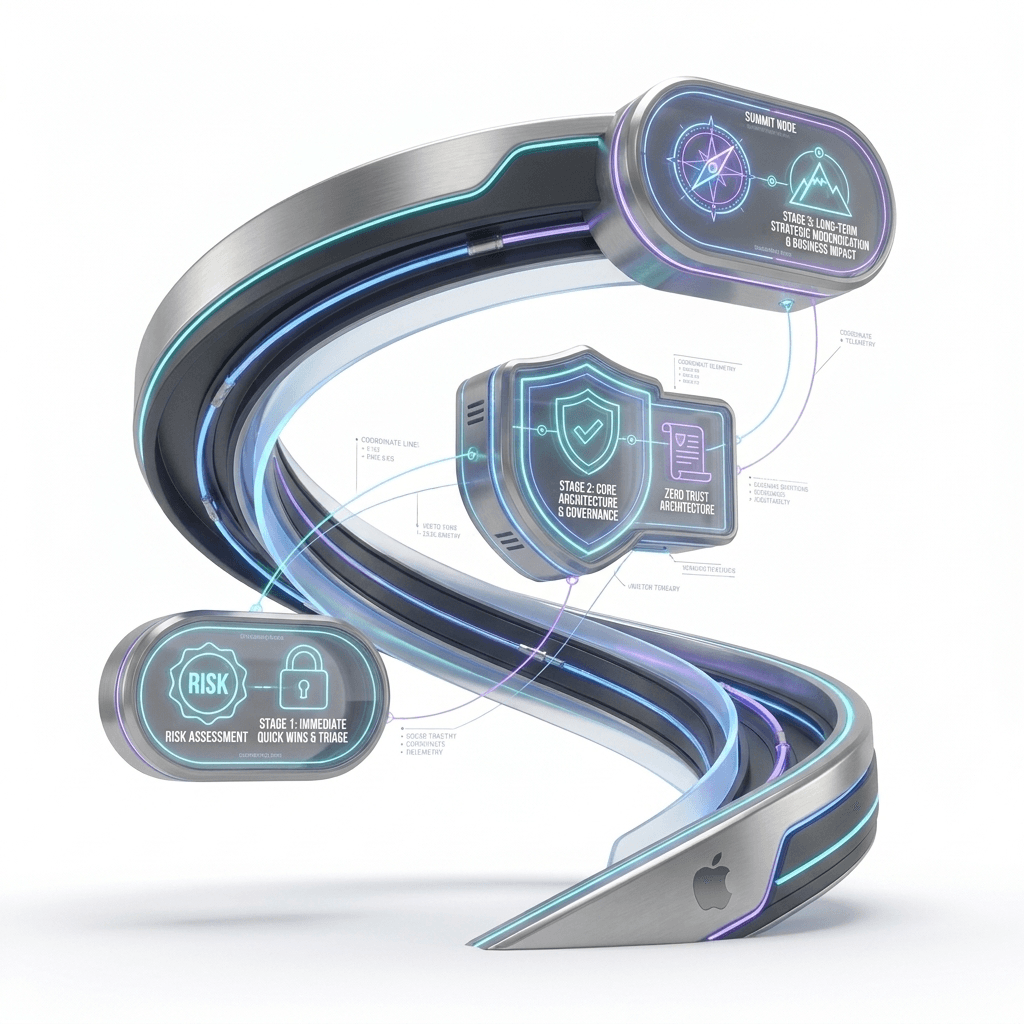
4. Roadmap and Strategic Alignment
We translate assessment findings and security priorities into a structured cybersecurity roadmap. The roadmap establishes what should be addressed first, what can be improved over time, and how security initiatives can align with broader technology and business plans.
Key activities include:
Prioritizing security improvements based on risk and business impact
Defining short-term security improvements and long-term initiatives
Establishing implementation milestones and dependencies
Mapping security initiatives to business and technology objectives
Defining governance and accountability requirements
Identifying integration requirements across existing systems
Establishing practical implementation priorities
Providing leadership with a structured view of the security improvement journey

5. Compliance Integration
Security requirements must work alongside the regulatory and compliance obligations that apply to your organization. We incorporate relevant privacy, security, and regulatory requirements into the cybersecurity strategy and implementation approach.
Key activities include:
Identifying applicable regulatory and contractual requirements
Mapping security controls to relevant compliance requirements
Addressing requirements related to data protection and privacy
Supporting alignment with standards such as ISO 27001
Considering applicable regulations such as GDPR and HIPAA where relevant
Identifying documentation and governance requirements
Establishing controls that support audit and compliance activities
Maintaining security and compliance considerations throughout the project lifecycle

6. Deployment and Integration
Once the security strategy and roadmap are defined, we support the implementation of appropriate security controls within your technology environment. Our team considers existing architecture, applications, infrastructure, workflows, and operational requirements during deployment.
Key activities include:
Implementing security controls across relevant environments
Configuring identity and access controls
Supporting secure infrastructure and cloud configurations
Integrating security controls with existing systems and workflows
Working with technology vendors and internal technical teams where required
Applying security requirements to applications and infrastructure
Supporting secure configuration and deployment practices
Minimizing operational disruption during implementation
Frequently Asked Questions
Let’s Collaborate!
Ready to turn your business goals and ideas into a practical digital solution? Let’s discuss your requirements, challenges, and objectives to determine the right technology approach and development strategy for your project.